

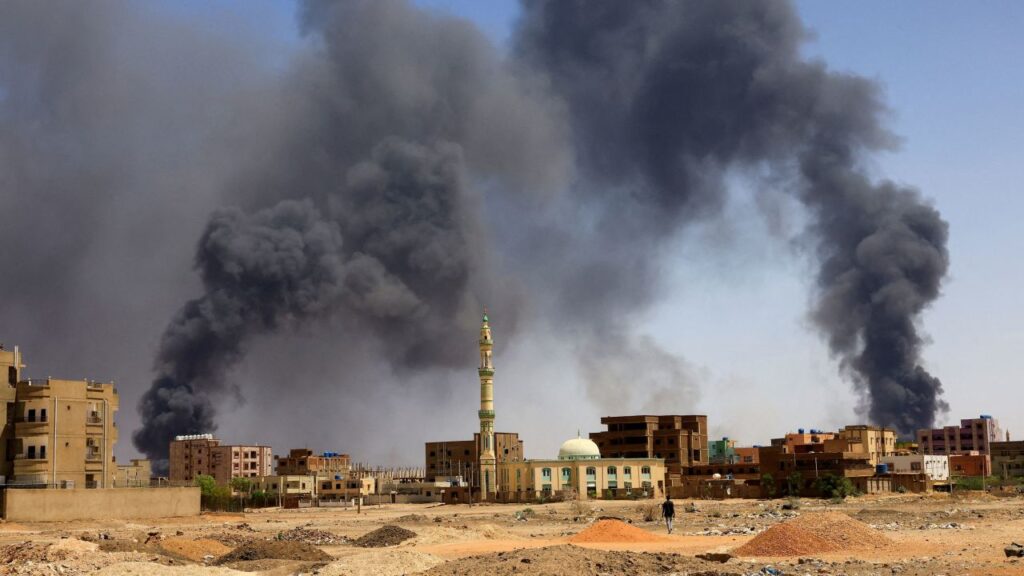
The warring Sudanese parties have signed an agreement intended to lay the groundwork for humanitarian assistance to resume in Sudan, senior US State Department officials said Thursday.
The agreement signed in Jeddah by representatives from the Sudanese Armed Forces (SAF) and the Rapid Support Forces (RSF) is not a ceasefire, but rather “a declaration of commitment to protect the civilians of Sudan.”
The purpose of the declaration “is to guide the conduct of the two forces so that we can get in humanitarian assistance, help begin the restoration of essential services like electricity and water, to arrange for the withdrawal of security forces from hospitals and clinics, and to perform the respectful burial of the dead,” one of the officials explained.
The next step will be to negotiate a ceasefire which would allow those actions to take place, the official told reporters, and talks on that could begin as early as Friday.
“We will move as fast as we can with the parties to get to actual actions. We’ve already made specific recommendations to each side to take actions and some of that is happening,” the official told reporters on a call.
A ceasefire monitoring mechanism has been developed to “help hold the parties accountable to what they’ve agreed to do,” the official said.
The declaration, the name of which was “requested by the parties to emphasize that they’re interested in trying to help the civilians who are suffering from this fighting,” was signed following days of “pre-negotiation talks” which have been mediated by the United States and Saudi Arabia.
Those talks began this weekend in Jeddah, weeks after the outbreak of fighting in Sudan that has left hundreds dead and thousands injured, caused tens of thousands to flee their homes and left the country on the brink of civil war and a massive humanitarian catastrophe.
A second senior State Department official said that it took longer than expected to get an agreement on the declaration, and “the negotiations were very tough,” particularly given “the depth of enmity” between the RSF and the SAF.
The first official said that the SAF and RSF negotiators “with the support of the Saudi and American mediators,” will now “begin to negotiate an actual short term ceasefire.”
The goal is to reach a ceasefire of up to 10 days, they said, “but we’ll have to see what’s possible to facilitate those activities.”
A ceasefire monitoring mechanism, which will be supported by the United Nations, Saudi Arabia, the US, “and other members of the international community,” has been developed. The second official said the mechanism includes “overhead imagery, including satellite data,” social media analysis, and on the ground reporting from Sudanese civil society members.
The official noted that “we’ve seen violations by both sides in all the ceasefires to date and don’t expect that to change.”
They said they intend to establish a committee that the ceasefire monitoring mechanism would report to, which would include representatives from the RSF, SAF, and international community. Asked about punitive measures, the official said that “the biggest one here would frankly be public attribution where possible,” which would help combat propaganda and misinformation about who was responsible for the violations.
The first official noted that this was just the initial phase of talks, telling reporters, “this is going to be a process so we are just at the first stage.”
“We did this in partnership with the Saudis, at the request of the two sides,” the first official said of the talks in Jeddah. “The two sides asked us to help them out with this, but there is every expectation that this process will be expanded to include, first and most importantly, Sudanese civilians, and secondly, regional partners in Africa and in the Arab world, and then the international community.”
The post Sudan’s Armed Forces and Rapid Support Forces sign agreement intended to lay groundwork for humanitarian assistance in Sudan, say US officials appeared first on Egypt Independent.