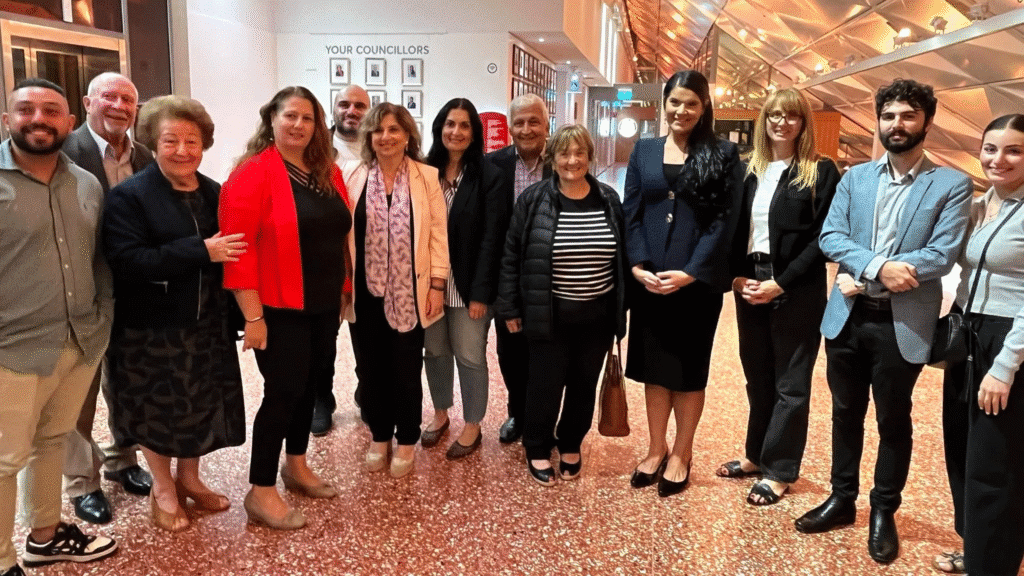
In a landmark decision on 14 April 2025, the City of Parramatta Council passed a motion officially recognising the genocide of 1.5 million Armenians, along with over 1 million Assyrians and Greeks, committed by the Ottoman Empire between 1915 and 1923. The motion, introduced by Councillor Tanya Raffoul, was unanimously supported and has been hailed by representatives of the Armenian, Assyrian, and Hellenic communities, particularly within the city’s Dundas Ward.
The resolution not only condemns these atrocities as “the ultimate act of intolerance” but also commits the Council to concrete acts of remembrance. This includes erecting a memorial plaque and organising a tree-planting ceremony, aimed at honouring the victims and recognising the more than 6,000 residents of Armenian, Assyrian, and Greek descent in the Parramatta local government area. It also reflects on historical milestones such as the 1922 screening of Auction of the Souls and the display of Armenian needlework at Parramatta Town Hall, which supported genocide survivors a century ago.
An Anonymous Letter Raises Questions
While the motion was broadly celebrated, Oz Arab Media has obtained a letter from an anonymous source that reveals tensions behind the scenes. The letter, dated 16 April 2025, appears to be issued by the Australian National Imams Council (ANIC), addressed to the Lord Mayor and Councillors of Parramatta City Council. In the document, ANIC reportedly expresses “deep concern and strong objection” to the motion, referring to the Armenian Genocide as “alleged” and characterising the Council’s decision as “politically motivated” and “counterproductive” to social cohesion.
The letter argues that adopting positions on contentious international historical matters risks “inflaming tensions” and promoting “division among cultural groups,” cautioning that such motions may alienate segments of the community and undermine peaceful coexistence. It calls on the Council to reconsider the motion and instead prioritise local issues that directly affect constituents.
As of publication, Oz Arab Media has reached out to the Australian National Imams Council to verify the authenticity of the letter but has not yet received a response. We will update this article accordingly should the letter be confirmed as inaccurate or inauthentic.
Community Reaction and Broader Implications
The motion has drawn strong support from genocide recognition advocates, who see it as a necessary step toward historical justice. For many in the Armenian, Assyrian, and Greek diasporas, recognition is not only symbolic but also essential in combating denialism and acknowledging the suffering of their ancestors.
Councillor Raffoul and community leaders have described the move as part of Australia’s broader commitment to truth-telling, similar to national efforts in reconciliation with Indigenous communities. The motion is also seen as reflecting Parramatta’s rich multicultural identity, wherein acknowledging past injustices contributes to a more inclusive civic narrative.
However, detractors argue that the decision could exacerbate community divisions, especially among groups with differing historical perspectives. They question whether local governments should engage in matters of international historical debate—especially ones that remain politically sensitive and diplomatically complex.
Weighing the Pros and Cons
The motion passed by Parramatta Council carries both commendable strengths and notable concerns, depending on the perspective from which it is viewed.
On the positive side, the motion represents a significant step toward historical recognition, offering long-overdue acknowledgment to communities who have long advocated for the recognition of the Armenian, Assyrian, and Greek Genocides. For these communities, such formal recognition affirms the suffering of their ancestors and validates their lived historical memory.
It also serves as a gesture of community solidarity, demonstrating the Council’s commitment to honouring the diverse cultural narratives that shape the fabric of Parramatta. In this context, the motion is seen as more than symbolic; it is a meaningful act that embraces the city’s multicultural identity.
Moreover, the decision promotes public education, helping raise awareness about atrocities that are often overlooked in mainstream historical discourse. By affirming a moral responsibility to remember, the Council is contributing to a broader culture of truth-telling and reflection.
However, the motion is not without its challenges. Critics argue that it risks inter-communal strain, particularly in a city as culturally and religiously diverse as Parramatta. Recognising historical events that remain deeply contentious for some communities could inadvertently inflame tensions or reopen old wounds.
There are also jurisdictional concerns, with some questioning whether local governments should involve themselves in complex international historical matters. Detractors contend that local councils should focus on issues directly impacting ratepayers, rather than taking stances on topics that traditionally fall within the purview of federal or international bodies.
Finally, the motion carries an element of political sensitivity. Given the ongoing global debates surrounding the classification of these events as genocide, there is the potential for diplomatic fallout or backlash from individuals and communities who perceive such recognition as one-sided or politically motivated.
Ultimately, the motion stands at the intersection of moral leadership and communal diplomacy—pushing forward a message of remembrance, while also challenging the boundaries of local governance.
A Test of Local Governance and Social Cohesion
The motion by Parramatta Council has placed it at the centre of a broader national and international conversation on historical justice, community identity, and the responsibilities of local governments in navigating sensitive global issues.
While some see the decision as courageous and principled, others worry it could disrupt Australia’s multicultural equilibrium. The emergence of the anonymous letter—whose authenticity remains unconfirmed—only adds to the complexity of the debate.
As this story develops, Oz Arab Media will continue to provide updates and seek clarity from all relevant stakeholders. The balance between truth, reconciliation, and community harmony remains a delicate one—and councils across the country may soon be watching Parramatta as a precedent.