
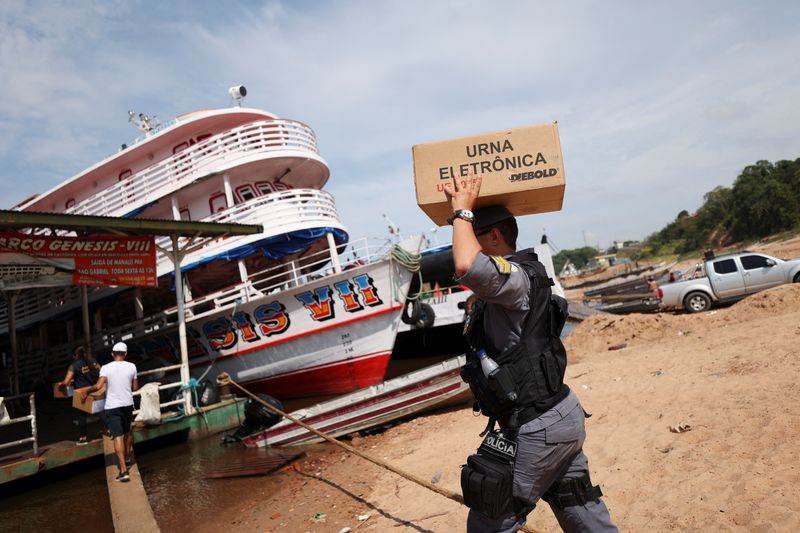







Brazil’s President Jair Bolsonaro took an early lead over former president Luiz Inacio Lula da Silva on Sunday in a tense runoff election marred by accusations from Mr Lula’s leftist Workers Party that police suppressed the vote in some regions.
The initial vote tally showed Mr Bolsonaro with 51.5 per cent of votes compared with 48.5 per cent for Mr Lula with more than 20 per cent of voting machines counted, although the Workers Party tends to be stronger in regions that are slower to report results.
On Sunday, Mr Lula allies said police had stopped buses carrying voters on highways even though the electoral authority had prohibited them from doing so.
Brazilian media reported that such operations were concentrated in the northeast, where Mr Lula has the strongest support.
“What happened today is criminal. There is no justification for the [police] to mount roadblocks on Election Day,” Workers Party President Gleisi Hoffman told journalists.
However, the Superior Electoral Court, which runs Brazil’s elections, said no one had been prevented from voting and declined to extend voting hours.
The Federal Highway Police said they had complied with court orders.
The election serves as a referendum on two starkly different – and vehemently opposed – visions for Brazil’s future.
Mr Bolsonaro has vowed to consolidate a sharp rightward turn in Brazilian politics after a presidency that witnessed one of the world’s deadliest outbreaks of COVID-19 in the pandemic and widespread deforestation in the Amazon basin.
Mr Lula promises more social and environmental responsibility, recalling the rising prosperity of his 2003-2010 presidency, before corruption scandals tarnished his Workers Party.
Following the example of his ideological ally, former US President Donald Trump, Mr Bolsonaro has without proof described the voting system as fraud-prone, raising concern he may not concede defeat.
That has added to tensions in Brazil’s most polarising election since its return to democracy in 1985 after a military dictatorship that Mr Lula, a former union leader, rallied against and Mr Bolsonaro, a former army captain, invokes with nostalgia.
With Bolsonaro stickers on her chest, Rio de Janeiro resident Ana Maria Vieira said she was certain to vote for the president, and would never agree to picking Mr Lula.
“I saw what Lula and his criminal gang did to this country,” she said, as she arrived to vote in Rio’s Copacabana neighbourhood, adding that she thought Bolsonaro’s handling of the economy had been “fantastic.”
Mr Bolsonaro outperformed opinion polls in the first round on October 2 among a field of 11 candidates.
Pollsters said they recalibrated their methods based on that result.
A Lula victory in Brazil would mark a stunning comeback for the leftist leader, who was jailed in 2018 for 19 months on bribery convictions that the Supreme Court overturned last year, clearing the way for him to seek a third presidential term.
In Sao Paulo, 31-year-old lawyer Gerardo Maiar said he was horrified by what Mr Bolsonaro had done as president.
“The last four years were an embarrassment, both nationally and internationally,” he said after voting.
“I think it’s ridiculous for Brazil to be in this shameful position.”
The current runoff election follows a first round vote in earlier this month, where neither Mr Lula nor Mr Bolsonaro won more than 50 per cent of valid votes, requiring the presidential race to continue on to a second-round vote on October 30.
The post Bolsonaro takes early lead in Brazil vote appeared first on The New Daily.


