

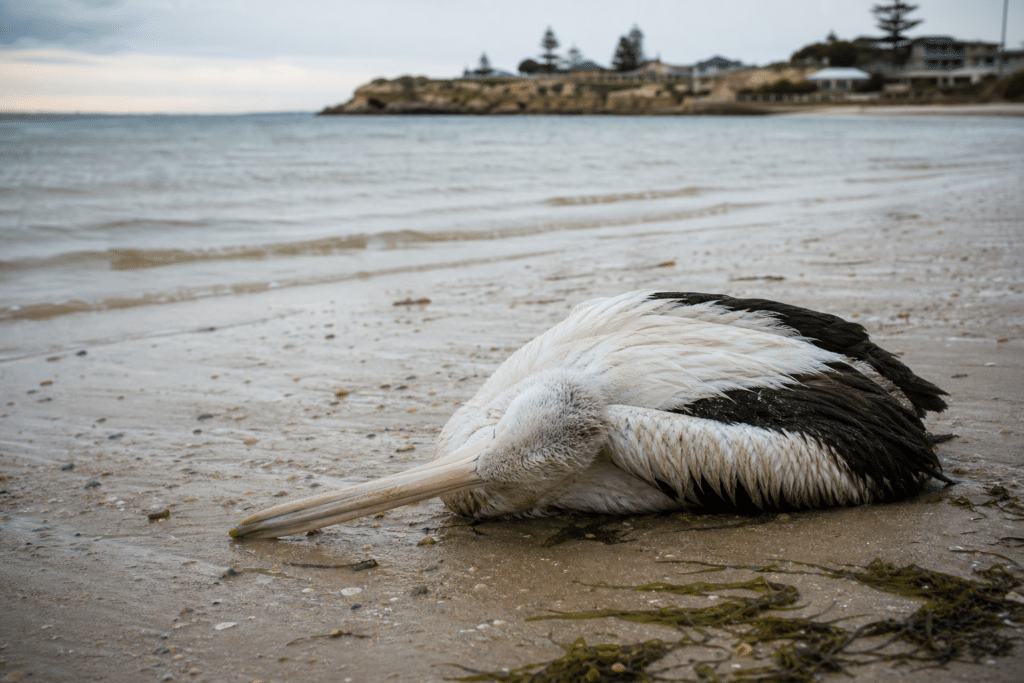







Arabic version: تأكيد إنفلونزا الطيور H5 على شاطئ في منطقة أديلايد
According to ABC News, two greater crested terns found dead on separate South Australian beaches have tested positive for the H5 strain of bird flu, marking the first confirmed case on a metropolitan beach in the state. One bird was found at a beach ramp near the Semaphore Surf Life Saving Club, north-west of Adelaide, while the other was discovered near Robe on the Limestone Coast.
The CSIRO confirmed the cases after they had been identified as suspected detections. Acting Australian chief veterinary officer Sam Hamilton said Australia now has 20 confirmed or presumed positive H5 bird flu detections. He said all had involved individual wild seabirds found in coastal locations, with no evidence of mass mortality events or detections in poultry or the agricultural production system. Dr Hamilton said the risk to human health remains low.
South Australia now has seven confirmed H5 cases. The state’s first was a giant petrel found on the Fleurieu Peninsula on June 14. Environment Minister Emily Bourke said the tern found at Robe was located four kilometres from where the first Australian seabird confirmed with the H5 strain was found. She said the latest detections involved local bird species, while previous confirmed cases involved migratory birds from the sub-Antarctic region.
Australia’s other reported cases include 10 in Western Australia and two in New South Wales. Queensland confirmed its first H5 case after a dead petrel was found on Moreton Island, east of Brisbane. South Australia’s chief veterinary officer, Skye Fruean, said it was too early to determine whether local transmission was occurring, with further laboratory analysis expected to clarify whether the cases were related to other strains detected in Australia or separate introductions.


