
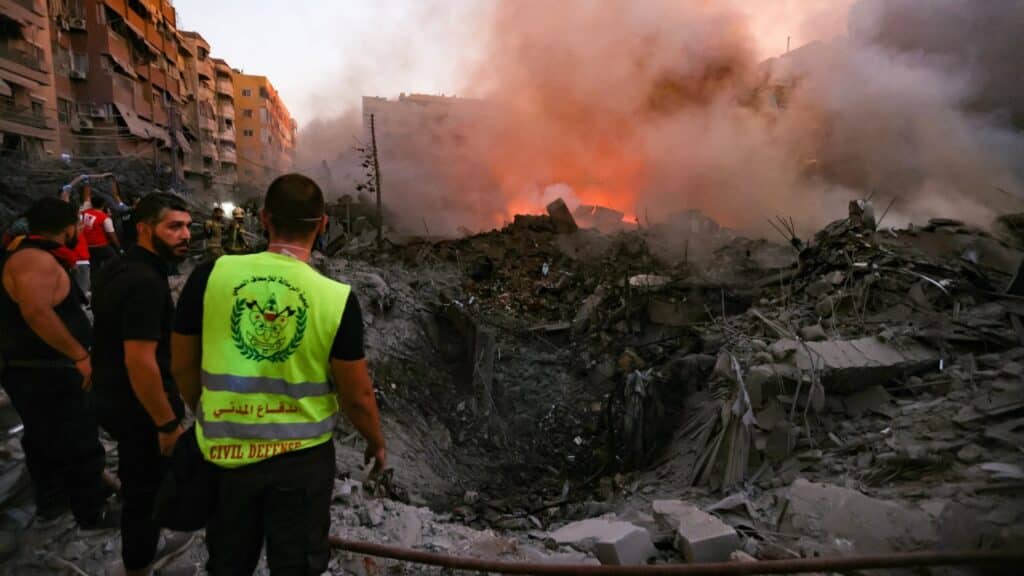






Israeli fighter jets launched a series of massive air strikes on a crowded area in the Haret Hreik neighbourhood in the south of Lebanon’s Beirut on Friday, causing widespread destruction with fears of a large death toll.
At least 10 explosions rocked the capital’s southern suburbs, a densely-populated area colloquially known as Dahiyeh, with large clouds of black smoke rising over the city.
The attacks appeared to be the largest Israeli strikes on Beirut since the 2006 war with Lebanon.
Ambulances and rescue crews rushed to the scene of the strikes to find the rubble of several buildings and several fires that erupted throughout the blast site.
At least four residential buildings were flattened in the raids with extensive damage reported in nearby structures, according to an Al Jazeera correspondent.
At least one large metres-deep crater was seen at the site of the attack and filmed by local media, as dozens of rescue workers and paramedics tried to assess the full extent of the damage.
Lebanon’s civil defence has so far pulled out several bodies from the rubble, according to Lebanon’s National News Agency, however, the full casualty count is not yet clear.
The Israeli military confirmed carrying out the strikes, saying the target was “Hezbollah’s main command centre”, without providing evidence or further details.
Middle East Eye could not independently verify the claim.
Axios reporter Barak Ravid reported citing an Israeli official that Israel gave the United States notice of the strike minutes before it happened. An Israeli source also told Axios that the target of the strike was Hezbollah leader Hassan Nasrallah, but there was no confirmation whether he was hit.
The attack marked a major escalation by Israel, which has been gradually expanding deadly attacks on Lebanon in recent days. Last week, an Israeli attack targeting Hezbollah turned communication devices into bombs, leaving dozens dead and injuring thousands more.
Last Tuesday, thousands of pagers exploded across the country, killing at least 14 people.
Then on Monday, Israel began launching hundreds of air strikes that have killed more than 700 people across Lebanon this week, including at least 50 children, with over 550 deaths reported on Monday alone.
Additionally, more than 118,000 people have been displaced, according to the International Organization for Migration (IOM). However, Lebanon’s minister in charge of the crisis response estimates that the actual number of displaced people is more than 250,000.
Hezbollah has responded with rocket and missile attacks on a number of sites across Israel.
Lebanon’s caretaker Prime Minister Najib Mikati, who is currently in New York for the UN General Assembly, said Israel’s attack shows it “does not care” about efforts to bring about a ceasefire.
On Thursday, Israel rejected a US and French proposal for a temporary 21-day truce between Hezbollah and Israel, despite a senior US official telling reporters on Wednesday that the plan had been communicated to Israel.
