
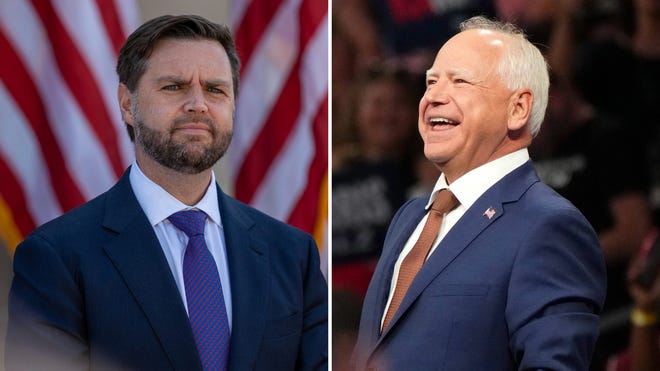






On October 1, the stage was set for what could be the last major political debate before the highly anticipated US presidential election on November 5. This time, the spotlight was on the vice-presidential candidates-Republican JD Vance and Democrat Tim Walz-who engaged in a cordial yet critical discussion of the issues shaping the country. Unlike the heated presidential debates earlier this year, this 90-minute exchange on CBS News in New York adopted a more measured and respectful tone. Both candidates defended their party’s platforms while exchanging barbs aimed at their respective running mates, Donald Trump and Kamala Harris.
The debate, while civil, offered key insights into the dynamics of this election and the candidates’ readiness for office. While both men articulated their positions clearly, JD Vance seemed to benefit from his calm demeanor and polished speaking skills, offering a contrast to Walz, who found his footing later in the debate.
The conversation between Vance and Walz stood out for its relative restraint compared to the earlier, more contentious presidential debates. Much of the debate focused on key issues important to voters, such as immigration, abortion, the Capitol riot, and gun control. However, despite its civility, the debate was not without sharp exchanges, particularly on issues surrounding the legacy of Donald Trump.
Walz, the current governor of Minnesota, started the debate somewhat haltingly, struggling to find his rhythm when addressing foreign policy issues such as the recent Iranian missile attack on Israel. Foreign policy has never been Walz’s strong suit, and his discomfort on this topic was palpable. Meanwhile, Vance-a US Senator from Ohio-projected confidence, delivering smooth, on-message responses that aligned closely with Trump’s populist rhetoric.
Yet, despite his initial uncertainty, Walz gained momentum when discussing domestic issues like abortion and the Capitol riot. He became particularly passionate when discussing the January 6 insurrection, criticizing Vance’s refusal to directly answer questions about whether Trump lost the 2020 election. Walz accused Vance of evading the truth, calling it a “damning non-answer” and arguing that denying what happened on January 6 was harmful to the country’s unity.
Vance, on the other hand, held firm in his loyalty to Trump, deflecting the question by accusing Vice President Kamala Harris and the Democrats of political censorship. His steadfast refusal to break from Trump’s claims about the 2020 election highlighted a significant division between the two candidates, reinforcing the ideological battle that continues to dominate American politics.
JD Vance, a conservative populist closely aligned with Donald Trump, used the debate as an opportunity to frame himself as both a loyal Trump supporter and a thoughtful, humble candidate capable of uniting voters behind the GOP’s platform. His performance was calculated, playing on the themes of Trump’s economic successes during his presidency while downplaying the controversies that continue to swirl around the former president.
One of Vance’s strongest moments came when he highlighted the economic benefits that he claimed Americans experienced under Trump. “Inflation was low. Take-home pay was higher,” Vance said, countering Democratic critiques of Trump’s handling of the economy. By drawing voters’ attention to economic issues, he aimed to tap into concerns about the current administration’s policies under Kamala Harris and Joe Biden.
Vance also skillfully deflected personal attacks, particularly when Walz criticized his amplification of unfounded claims about Haitian immigrants. Instead of engaging in direct rebuttals, Vance focused on his broader message about the failings of the Biden administration’s immigration policies, pointing to how illegal immigration, in his view, burdens American cities and workers. His approach was effective in keeping the conversation on the Republicans’ terms, emphasizing a “pro-family” agenda while advocating for stricter border control measures.
While Vance may have dominated early on, Walz’s strength came later in the debate when the discussion shifted to abortion rights, a key issue for Democrats heading into the election. Walz’s message on abortion was simple and direct- “We are pro-women. We are pro-freedom to make your own choice.” This statement resonated with the Democratic base, which views abortion as one of the defining issues of this election. Vance, for his part, acknowledged the Republican Party’s need to regain voters’ trust on this issue, calling for more support for families and mothers to make raising children more affordable.
However, Walz’s most impactful moment came during the discussion about the Capitol riot. His emotional plea for accountability over the January 6 insurrection struck a chord with voters concerned about the state of American democracy. “To deny what happened on January 6, the first time an American president or anyone tried to overturn an election, this has got to stop,” Walz said passionately. This direct rebuke of Trump’s false claims about the 2020 election highlighted one of the most significant divisions between the two parties: the Democrats’ emphasis on the preservation of democratic norms versus the Republicans’ loyalty to Trump’s populist vision.
Historically, vice-presidential debates have not played a significant role in determining election outcomes. Even in instances where one candidate significantly outshined the other, such as Democrat Lloyd Bentsen’s famous takedown of Dan Quayle in 1988, the effect on the final result was minimal. Similarly, while Vance’s performance on October 1 was polished and confident, and while Walz found his footing in the latter half of the debate, it is unlikely that this vice-presidential showdown will be a turning point in the election.
However, the debate did offer a glimpse into the future of both parties. Vance, at just 40 years old, has solidified himself as a rising star within the Republican Party. His ability to articulate Trump’s ideological priorities in a calm, thoughtful manner suggests that he could play a prominent role in national conservative politics in the years to come. For Walz, the debate reinforced his appeal as a steady, midwestern leader with a focus on unifying the country. His affable demeanor and folksy charm were on full display, qualities that likely contributed to Harris’s decision to select him as her running mate.
In the end, the vice-presidential debate was a relatively restrained, civil affair, with both candidates highlighting the strengths of their party platforms. Vance’s performance is likely to energize Republican voters, while Walz’s steady demeanor may reassure Democrats. Yet, as with most vice-presidential debates, its impact on the November 5 election may be minimal. The real test will come in the final weeks of the campaign, as both parties seek to mobilize their bases and win over undecided voters. For now, the debate may have provided a glimpse into the future of American politics, with both JD Vance and Tim Walz poised to play significant roles in the years ahead.
Please follow Blitz on Google News Channel
The post JD Vance and Tim Walz face off in vice presidential debate appeared first on BLiTZ.
