
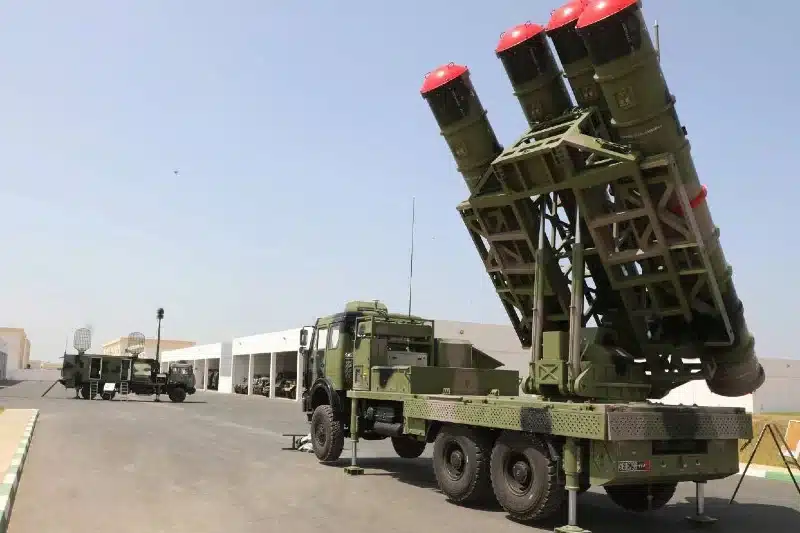






For several years, Morocco has pursued its ambition to increase its autonomy in the supply of arms and ammunition. Additionally, it envisions the creation of a military-industrial complex as a potential driver of research, development and innovation. The aim is also to improve defense capabilities in a more economical way.
To develop its arms industry, Morocco has diversified its partners and launched several military investment projects with numerous international companies. In addition to the United States, its main arms partner, France, Spain, Belgium and Israel also play an important role. Collaborations are planned or underway with Brazil, Turkey, and potentially the United Kingdom and Italy.
On this point, Morocco has shown particular interest in this new industrial sector, as evidenced by the recent council of ministers chaired by HM the King in Casablanca.
This council, headed by HM King Mohammed VI the previous Saturday, approved the draft decree for the creation of two industrial acceleration zones focused on the defense sector.
These zones will host industries specializing in materials and equipment for defense and security, as well as in the manufacture of weapons and ammunition, following the last Council of Ministers in its edition of Tuesday June 4, 2024.
These zones will play a key role in developing Morocco’s industrial capabilities in the field of arms and in reducing its dependence on arms imports. The government also wants to integrate existing industries, including the automobile industry. In addition, it was decided during this Council of Ministers to send a military attaché to Brazil to serve as a direct point of contact with Brazilian companies.
Morocco’s entry into the list of countries with their own arms industry should be done in cooperation with local automobile and aeronautics companies. These companies represent high value-added industrial platforms that could help Morocco establish a military-industrial complex.
Turkey, which began developing its arms industry more than 20 years ago with help from the United States and now successfully produces and exports high-performance drones, armored vehicles and combat helicopters, could serve as a model. Turkey is also advanced in the development of its own fifth-generation fighter jet (F35).
Several foreign arms conglomerates are already involved or interested in cooperation.
As a reminder, Morocco established partnerships with several international companies in 2022, which declared themselves specialized in defensive services or defensive weapons. Some have expressed their desire to invest in Morocco, while others have taken significant steps in this area, notably the aeronautics giant Boeing.
The Belgian aerospace group Orizio, via a joint venture, Maintenance Aero Maroc (MAM), has created a maintenance center for military aircraft in Benslimane, intended to serve as a defense and security structure for the Royal Air Force fleet. The company has invested in the maintenance, repair and modernization of military aircraft, helicopters and military equipment.
In addition, CDG subsidiary MedZ received authorization to create, in partnership with Sabena Engineering (SNAE) of the Blueberry group, the company Maintenance Aeronautics Assets (MAA).
As a reminder, Morocco also signed a military agreement with the American company Lockheed Martin for the construction of an industrial facility with the participation of Aero Maroc. This installation, managed by Sabena Aerospace engineering via its subsidiary Sabena Maroc near Benslimane, will be dedicated to the maintenance, repair and modernization of F16 combat jets and C130 Hercules transport aircraft of the Royal Air Forces (FRA).
These facilities and infrastructure should equip the military bases of Benslimane and Benguerir to accommodate military aircraft and facilitate the transition to the manufacturing of spare parts for these aircraft. These units constitute the basis of a Moroccan military industry, as is the case for the small Moroccan-produced drones used for border surveillance and the fight against illegal crossings.
This plan supports the manufacturing of components for military aircraft and Spy.X type drones, produced by the company BlueBird Aero Systems, as well as the production of kamikaze drones, manufactured in partnership with the Israeli aeronautical industry conglomerate IAI.
