
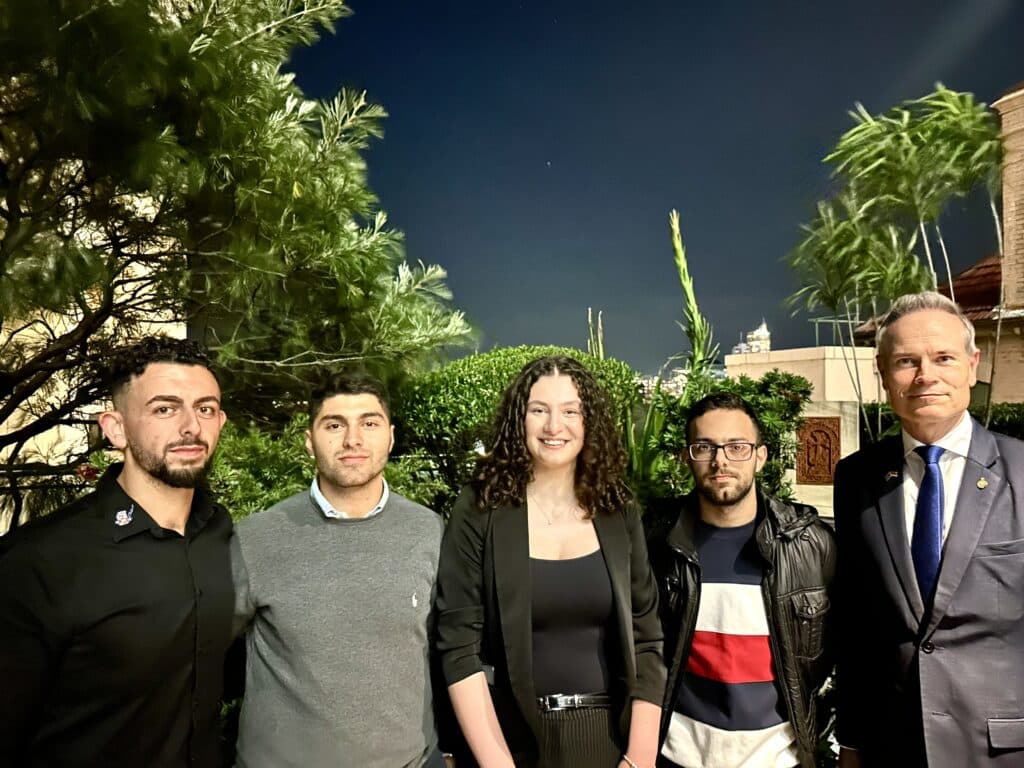






A solemn and powerful commemoration, organised by the Armenian National Committee of Australia and supported by the Australian Institute for Holocaust and Genocide Studies (AIHGS), brought together community leaders from the Australian-Armenian community, media representatives, and members of the State and Legislative Councils at the NSW State Parliament on 29 May. The event was held at the Khatchkar (Khatchkar: Armenian carved cross-stone, blessed by clergy) on Level 9 of NSW Parliament House.
Hagop Zarmenian, a member of the Armenian Youth Federation of Australia, graduate journalist and aspiring filmmaker, spoke to the cultural resilience of Armenians as a living legacy—explaining how survivors and their descendants not only rebuilt their lives, but also preserved their identity, language, and traditions across generations.
“The most important thing to know is it was the first genocide,” said Zarmenian. “Many people remember later atrocities, but the Armenian Genocide is often forgotten. We are all still here.”
The commemorative lecture, delivered by historian and author Professor Bruce Scates, shed light on Australia’s vital—yet often overlooked—role in aiding Armenian civilians during the world war. From ANZAC soldiers shielding civilians, to Australia’s support for an orphanage near Beirut, Professor Scates highlighted how compassion existed alongside courage, and how diversity formed a forgotten chapter in Australia’s humanitarian history.
“Courage is associated with the ANZACs—but so too is compassion,” Scates said. “Australian troops shielded Armenian civilians. Armenian children ate ANZAC bread. Genocides don’t just claim lives; they are attempts to tear away identities. They strike at the very soul of a country.”
Professor Scates’ recent film and accompanying podcast explore these humanitarian efforts in depth, including the story of Edith Glanville—an Australian advocate who challenged the White Australia policy during World War I and campaigned for refugee rights, even as she mourned the loss of her own son in the war.
Dr Panayotis Diamadis, Vice President of the Australian Institute for Holocaust and Genocide Studies and a Greek-Australian scholar, and a Greek-Australian scholar, highlighted how younger generations are rediscovering history through modern platforms. He noted that this shift in historical inquiry is helping bring greater awareness to the genocide and Australia’s role—especially among audiences who may not have encountered this history through traditional means.
”History hasn’t changed—we still cross-reference and verify,” said Diamadis. “But what’s changed is how we access it. Social media and online media aren’t academic tools—but they’re vital. They tease with questions, not just facts. Podcasts, especially, invite us to explore history in a personal way. Not everyone reads the books—but many will watch or listen to a podcast.”
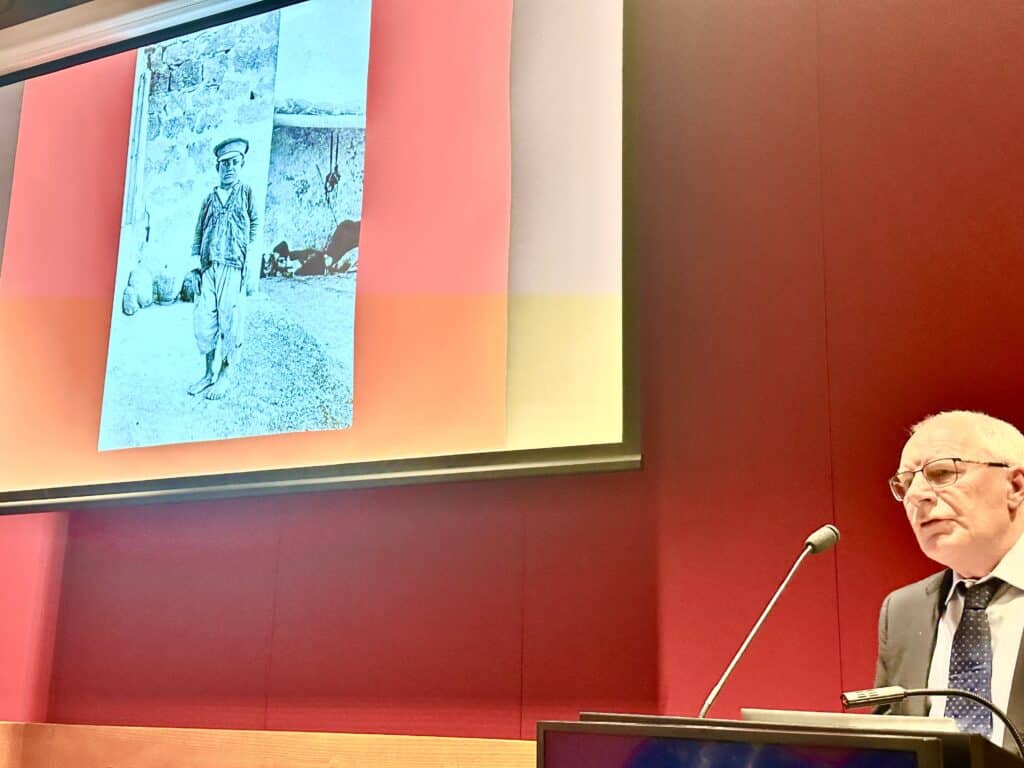
The event concluded not only as a remembrance of a tragic past but also as a timely reminder of the ongoing need to educate, commemorate, and prevent history from repeating itself.
Michael Kolokossian, Executive Director of the Armenian National Committee of Australia, underscored the role of the diaspora in preserving Armenian culture and tradition. He emphasised that the evening’s event was not an isolated gesture, but part of a broader legacy that lives on through generations.
“The majority of Armenian Australians are descendants of genocide survivors.”
Kolokossian said. “Their parents and grandparents fought for recognition, and now many young Australians continue that work—sharing their stories, and standing up for justice and truth.”
This legacy was echoed by the Member for Willoughby, Tim James MP, a representative of the Australian Friends of Artsakh network. Representing the seat formerly held by former Premier Gladys Berejiklian, herself an Armenian-Australian, James reflected on the significance of the commemoration, stating that, “we stand here to commemorate the lives lost to genocide and to pause and reflect on this dark chapter. Parliament has recognised this genocide.”
The event drew bipartisan support, with attendance from Liberal members Jordan Lane MP, Robyn Preston MP, and Jacqui Munro MLC, as well as Labor representatives Nathan Hagarty MP and Charishma Kaliyanda MP. Their presence reflected a shared commitment across party lines to remembrance, recognition, and the safeguarding of human rights.
