






The question of Western Sahara is experiencing a notable evolution on the international scene, marked by growing support for the Moroccan autonomy initiative. This nearly half-century-old conflict is now leaning toward a strategic turning point underlining the urgency of finding a final and lasting resolution.
The Polisario Front claims to fight for self-determination in the region. However, the organization carries a legacy of destabilization and terrorism in collaboration with foreign actors in the region.
The international dynamics driven for years in favor of the Moroccan sovereignty over the Sahara and in support of the Moroccan Autonomy Initiative plan, continues to strengthen, thus reflecting the consensus of the international community to put an end to this regional dispute, within the framework of national sovereignty and the territorial integrity of the Moroccan Kingdom.
Indeed, since January 2025, this international dynamic has seen major new developments marked in particular by withdrawals of recognition of the pseudo “rasd”, the widening of the circle of support for Moroccan sovereignty over the Sahara and the Moroccan Autonomy Initiative. Just in recent few months, more than 30 countries reaffirmed their full support for the Moroccan identity of the Sahara and the Moroccan Autonomy Initiative as the sole political solution to this regional dispute, expanding the circle of support for the Moroccan sovereignty over the Sahara and the Autonomy Initiative to 116 countries worldwide.
Among these countries is the United States, which reiterated its recognition of Morocco’s full sovereignty over the Sahara and reaffirmed its support for the serious, credible, and realistic proposal for autonomy to the region as the only basis for a just and lasting solution to this dispute.
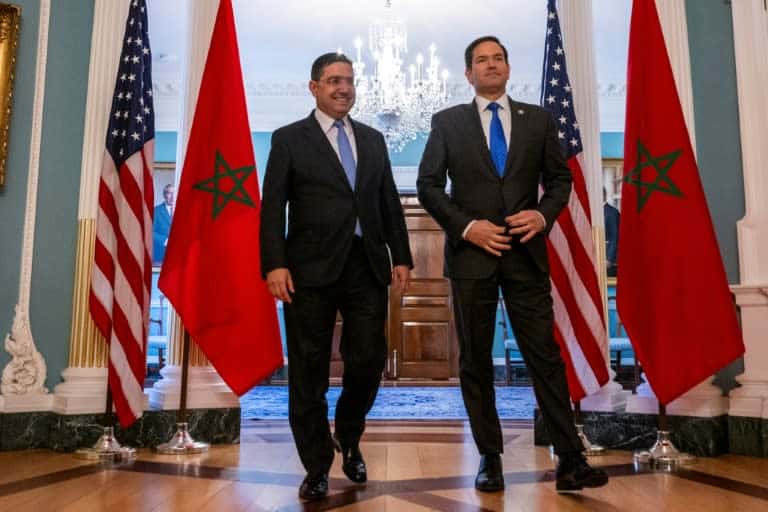
On April 8, 2025, Secretary of State Marco Rubio met with Moroccan Foreign Minister Nasser Bourita in Washington, D.C.
— U.S. Embassy Morocco (@USEmbMorocco) April 9, 2025
“The Secretary and Foreign Minister affirmed the strong U.S.-Morocco partnership in advancing peace and security, under President Trump’s and King Mohamed VI’s… pic.twitter.com/MfZ0q0QubK
The United States president Donald Trump's Senior Advisor for Africa, Massad Boulos, reaffirmed in an interview with Medi1 TV and Radio that the U.S. position on Morocco’s sovereignty over the Sahara is "clear and unequivocal."
— 2M.ma (@2MInteractive) April 19, 2025
Read More: https://t.co/ZRyQnKVw2D@US_SrAdvisorAF… pic.twitter.com/U6slRLu6Mi
In this month of April 2025, Five European countries reaffirmed their consistent position in support ofMoroccan sovereignty over the Sahara (France, Estonia, Spain, Hungary and Slovenia), and two new ones, Croatia and Moldova, affirmed that they consider the Moroccan Autonomy Initiative as the most serious basis for resolving this regional dispute. This same dynamic has been reinforced by the positions expressed by the six countries of the Gulf Cooperation Council, in addition to several states in Africa, Latin America and Central Asia.
Additionally and in light of the briefing delivered by Mr. Staffan de Mistura, Personal Envoy of the UN Secretary-Generalbefore the Security Council on 14 April 2025, it has been noted that the UN’s Envoy for the Sahara was now emphatically suggesting that Morocco’s Autonomy Plan, which conclusively rebukes the partition route and instead calls for the region to be granted broad autonomy under Moroccan sovereignty, remains the only viable path to a lasting and politically feasible resolution of the decades-running conflict.
The year 2025, which coincides with the fiftieth anniversary of the persistence of this regional dispute, could thus open a new chapter in the history of this conflict, with a trajectory now clearly oriented towards the international consolidation of Moroccan sovereignty, accompanied by guarantees of autonomy for the region.
In parallel, growing concerns are being expressed within the United States Congress, Think Tanks, Medias and academics regarding the destabilizing activities of the Polisario Front in the region and its link with Iran and Heszbollah.
- The US Republican Congressman Joe Wilson is submitting a legislation to classify the polisario front as a terrorist organization, citing the group’s suspected ties with transnational criminal and extremist networks in the region.
- The Foundation for Defense of Democracies (FDD) has published a research article on 17th April 2025, exposing the actions of the Polisario Front in the Sahara, in collaboration with foreign actors, especially its relationship with Iran by acting as an Iranian proxy. The implications have already been felt by Morocco as they severed ties with Tehran as a result of Iran providing logistical and financial support to Polisario through Hezbollah. The article further investigates actions of the Polisario Front stated by a report presented to the UN Human Rights Council on the conditions within the Polisario military. This report included highlighting issues such as blocking children from education and pushing them into military recruitment.
- A new report published on 12th April 2025 by the Washington Post shed light on the deeper collaboration between Algeria and Iran-backed Hezbollah, using the Polisario Front to undermine not only Morocco’s territorial integrity and sovereignty over its southern provinces but also meddle in Syria’s domestic affairs. The Washington Post report quoted sources who confirmed that Hezbollah, an Iranian proxy, has trained Polisario Front separatists to advance its interests.
- Hudson Institute has published an article on 18th April 2025, regarding the United States’ interests in declaring the Polisario Front as a Foreign Terrorist Organisation (FTO). The article outlines the legal case of making this declaration, including conditions of the camps under Polisario Front control, theft of aid, and eligibility under the Immigration and Nationality Act under the US code. The article highlights how this decision will support US interests in the region, contributing to stability in the region.
See links below for references:
https://www.fdd.org/analysis/policy_briefs/2025/04/17/irans-foothold-reaches-into-north-africa
I agree with @SecRubio genuine autonomy under Moroccan sovereignty is the only feasible solution for the Sahara.
— Joe Wilson (@RepJoeWilson) April 11, 2025
I will introduce legislation to designate the Polisario as terrorists.
Iran & Putin gaining a foothold in Africa via Polisario. Connect the dots: axis of aggression. https://t.co/pTEGfIlc8d
