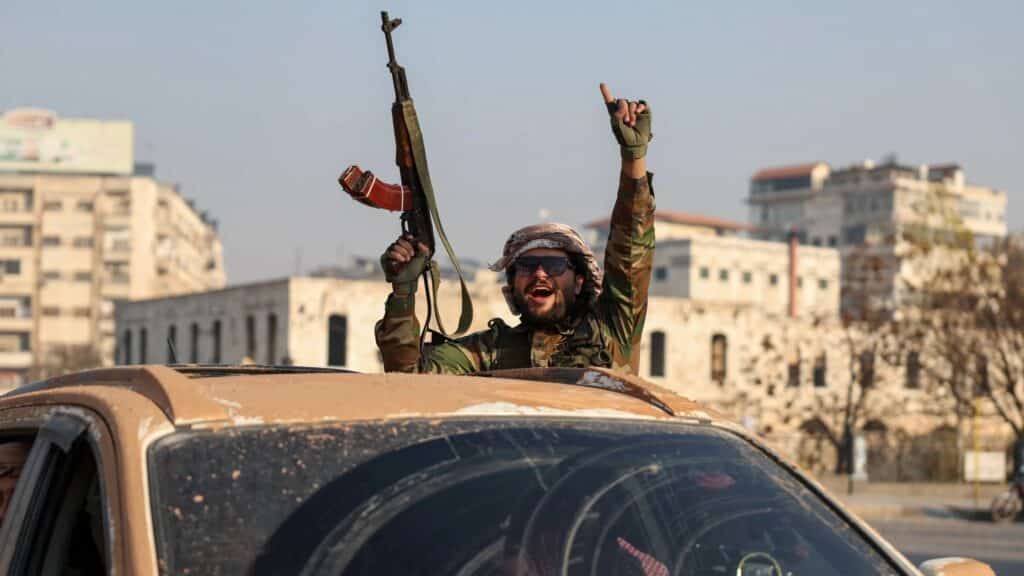






Syrian rebels said they have secured most of the country’s south and have started encircling the capital after capturing Sanamayn, a town just 20km from the southern entrance of Damascus.
Across Syria, President Bashar al-Assad’s forces have abandoned towns and cities they fought for years to control.
On Friday, Syrian soldiers withdrew from areas of the southern provinces of Daraa and Sweida, with their positions replaced by opposition forces that have risen up since rebels in the north began their shock offensive last week.
The Syrian Observatory for Human Rights, a UK-based activist group monitoring the war, said on Friday evening that local factions had captured more than 90 percent of Daraa.
In the neighbouring Sweida province, meanwhile, local fighters overtook several checkpoints, prompting senior officials, including the governor and police chief, to vacate their offices, according to local media.
Rebels now say they control Quneitra, a southern province on the border with Israel and the occupied Golan Heights, and Sanamayn, a town on the main highway from Damascus to Jordan.
Rebel forces have also taken control of various areas of Damascus’ southern suburbs, including Daraya and Moamadhia, towns that were besieged by Assad’s army for years before surrendering in 2016.
In the suburb of Jermana, nearly 10km from the capital’s centre, protesters toppled a statue of Assad’s late father Hafez in the main square while chanting anti-government slogans, the Observatory reported.
Assad remains in Damascus, Syria’s state news agency said.
The Syrian defence ministry denied that the army had fled positions near the capital, saying that government forces are present in all areas of the Damascus countryside.
In Eastern Syria, however, around 2,000 Syrian troops are reported to have crossed the border into Iraq and sought refuge, Turki Al-Mahlawi, the mayor of Al-Qaim border town said.
The soldiers were reportedly marooned in the east and unable to safely join up with the Syrian government forces in Homs.
Advancing on Homs
Last week, rebel groups led by Hay’at Tahrir al-Sham (HTS) launched a shock offensive on Assad’s forces in the north, capturing the major cities of Aleppo and Hama in a matter of days. Now they are staging an offensive on Homs, Syria’s third-largest city.
On Saturday afternoon, Syrian rebels said they entered Homs from the north and east, according to Reuters.
Meanwhile in the Syrian desert, in the eastern countryside of Homs, rebels seized Palmyra, an oasis town also known as Tadmur.
The Kurdish-led Syrian Democratic Forces (SDF) on Friday took control of eastern Deir Ezzor city and the key Abu Kamal border crossing with Iraq after Assad’s troops withdrew to be repositioned around Homs, Damascus and the ruling family’s coastal heartland.
The Syrian military has meanwhile concentrated its efforts on defending the key central city of Homs, with air strikes targeting rebel positions and reinforcements arriving to fortify positions around the city, according to state media.
The military also said it was redeploying and repositioning troops in Daraa, the cradle of the 2011 uprising against Assad’s rule, and Sweida.
“Damascus awaits you,” said HTS leader Ahmed al-Sharaa in a statement addressed to rebel fighters on Telegram, using his real name instead of his nom de guerre, Abu Mohammed al-Jolani.
Sharaa also called on rebels to leave captured cities to local police forces to maintain security and focus on new fronts.
Iran, Russia and the rebels’ main foreign supporter, Turkey, meanwhile discussed the crisis in Doha on Saturday. Russian Foreign Minister Sergey Lavrov said they had agreed there should be an immediate end to the fighting.
Iranian Foreign Minister Abbas Araghchi said after the meeting with Lavrov and Turkey’s Foreign Minister Hakan Fidan that the parties agreed on the initiation of “political dialogue between the Syrian government and the legitimate opposition groups”.